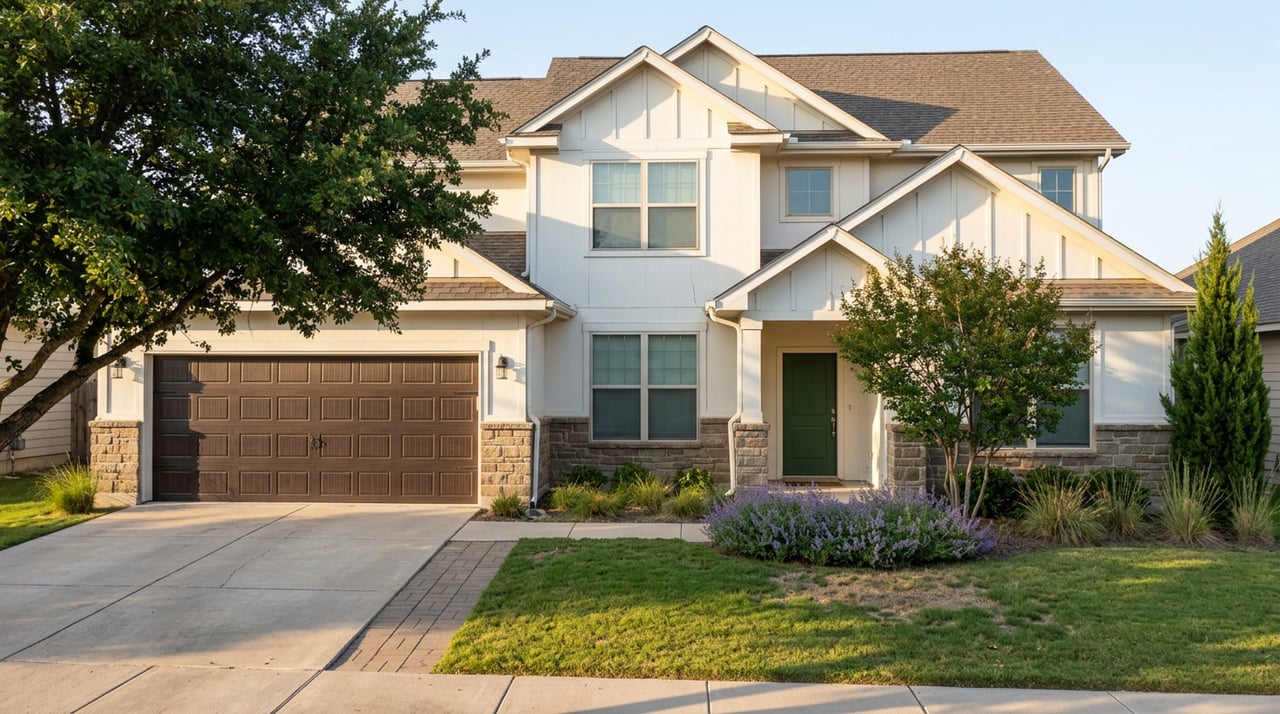
Scroll through the listing copy for new construction in Willow Bend and you'll find a line that reads like a settled fact: homes here sit near "a light rail station a quarter mile away." It's the kind of detail that quietly does a lot of work in a buyer's head. Commute time. Resale story. The sense that this corner of Thornton is already plugged into something bigger.
Stand at that corner today, at Holly Street and 144th Avenue, and you won't hear a train. You won't see track. What you'll find is a planning document, a funding request, and a number that only just moved for the first time in six years.
The station has been "almost funded" since 2020
When RTD opened the first 13 miles of the N Line in September 2020, running from Union Station to 124th Avenue in Thornton, the agency was upfront about what came next. Stations at York Street and 144th Avenue, and another farther north at Highway 7, were on the map but not on the budget. RTD's own language at the time was that it would build them "as soon as RTD can secure the money."
That's the same sentence that's been true, unchanged, for the better part of six years. Willow Bend itself was built into that gap. The Willow Bend Metro District describes the neighborhood as a covenant-controlled community of 494 single-family homes constructed between 2019 and 2024, meaning every phase of construction happened while that future station sat exactly where it sits now: promised, not built.
What actually changed this summer
In late July 2026, RTD's board did something it hadn't done in years. It allocated $12 million toward the final 5.5 miles of the N Line, the stretch that includes the York/144th stop. That's real money and a real milestone. It's also, specifically, money for pre-construction work: environmental review, corridor validation, and engineering that brings a decades-old design up to current standards.
Adams County's public works director framed the moment carefully in the county's own announcement, calling it important because officials need to "reevaluate things done in the past and approach this extension appropriately." That's not the language of a station about to open. It's the language of a project moving from dormant back into active planning, with construction funding still to be found.
To build momentum, Adams County says it's now working alongside Thornton, Westminster, Commerce City, and the Colorado Department of Transportation to form a coalition that will lobby for the funding still needed to actually build the thing. Thornton, for its part, has opened two Station Area Master Plans, one for York at 144th and one for North Thornton at Highway 7, to get zoning and land use ready for whenever the trains arrive.
The gap between $12 million and the real number
Here's the part that doesn't show up in a builder's marketing copy. A September 2025 RTD report put the true cost of finishing the N Line extension, alongside the Northwest Rail Peak Service to Longmont, at nearly $1 billion. Against that, RTD had roughly $441 million available across its full FasTracks program, and its own best-case forecast projected only $145 million from internal savings by 2030.
| Funding Question | Amount / Status |
|---|---|
| Cost to complete N Line extension + Northwest Rail Peak Service | Nearly $1 billion (RTD, Sept. 2025 report) |
| Total FasTracks funding currently available | Roughly $441 million |
| Best-case internal savings projected by 2030 | $145 million |
| Potential added state funding, 2026–2034 (SB 21-260, SB 24-230, SB 24-184) | Up to $296 million |
| New money allocated toward N Line extension, July 2026 | $12 million, for pre-construction only |
Even in the most optimistic reading, where every dollar of projected state funding actually arrives on schedule, RTD is still working toward a fraction of what full construction costs. The $12 million is the first real step in years. It is not the step that puts steel in the ground.
What a real amenity looks like next to it
None of this means Willow Bend is short on things that are actually there. Trail Winds Park and the adjoining Trail Winds Recreation Center sit close by, with fields, a skate park, and a pool. Those are built, staffed, and open today. The difference matters because it's the difference between an amenity you can walk to this weekend and an amenity that shows up in marketing copy as if it already exists.
That's the real thesis here, and it's worth stating plainly: a "quarter mile from light rail" claim in Willow Bend right now describes a possible future, priced into the present. It's not a lie. It's closer to a call option, something that could pay off in higher long-term value or shorter commutes, but only if a funding gap measured in the hundreds of millions closes on a timeline nobody, including RTD, has committed to.
What to actually ask if transit access is part of your decision
If you're weighing Willow Bend against another North Denver neighborhood partly because of proximity to future rail, a few questions separate a grounded decision from an assumption borrowed from a builder's brochure:
- Is the station funded for construction, or only for planning and pre-construction work like environmental review and engineering?
- Has the relevant Station Area Master Plan been adopted, or is it still in community outreach?
- What's the most recent public statement from RTD or Adams County on a construction timeline, and how recent is it?
- If the station's value is part of your long-term resale thinking, how does the home perform on its already-built amenities alone?
None of these questions require a leap of faith. They're all answerable through public county and transit agency records, and the answer changes month to month as coalitions form and funding requests move through RTD's board.
What this means if you're deciding now
Buyers sometimes treat "near future transit" as a settled amenity because it's presented that way, confidently, in a floor plan brochure. The more honest version is that Willow Bend sits in a neighborhood-building moment that happens to overlap with a transit-funding moment, and the two are not yet the same thing. That overlap could resolve in the neighborhood's favor. It has, in other Denver suburbs, before. But it hasn't resolved yet, and pricing your decision as if it has means paying for a train that, as of this fall, still needs several hundred million more dollars before it runs.
A few questions we get
Is there any train service near Willow Bend today? Not yet. The nearest operating N Line station is farther south, and the York/144th stop that would sit closest to Willow Bend is still in the pre-construction phase as of the RTD board's July 2026 funding action.
When will the York/144th station actually open? There's no confirmed construction date. The $12 million approved in 2026 funds design and review work, not building. Future funding depends on additional state allocations through at least 2034 and on RTD's broader FasTracks priorities.
If you're comparing Willow Bend to other Thornton and Westminster neighborhoods and want the real picture, not the brochure version, that's exactly the kind of digging Jackie Roacho does before you write an offer. Schedule a free consultation and let's talk through what's actually built, what's actually funded, and what's still just a promising line on a planning map.